A one-person AI company, run like a 65-person org
SAGE7 has one employee and an org chart. How I staff it with agents, which decisions never leave my hands, and why a new product reaches production in under 15 minutes.
SAGE7 AI has one employee: me. It also has an org chart. In the last twelve months that org shipped four papers, 25 open-source libraries, 13 upstream fixes to vLLM, litellm and mem0, a production platform on its own Kubernetes cluster, and agent deployments inside customers' finance and energy teams. This is how the org is built, which decisions never leave my hands, and what I learned from running 65-person organizations that turned out to be the point.
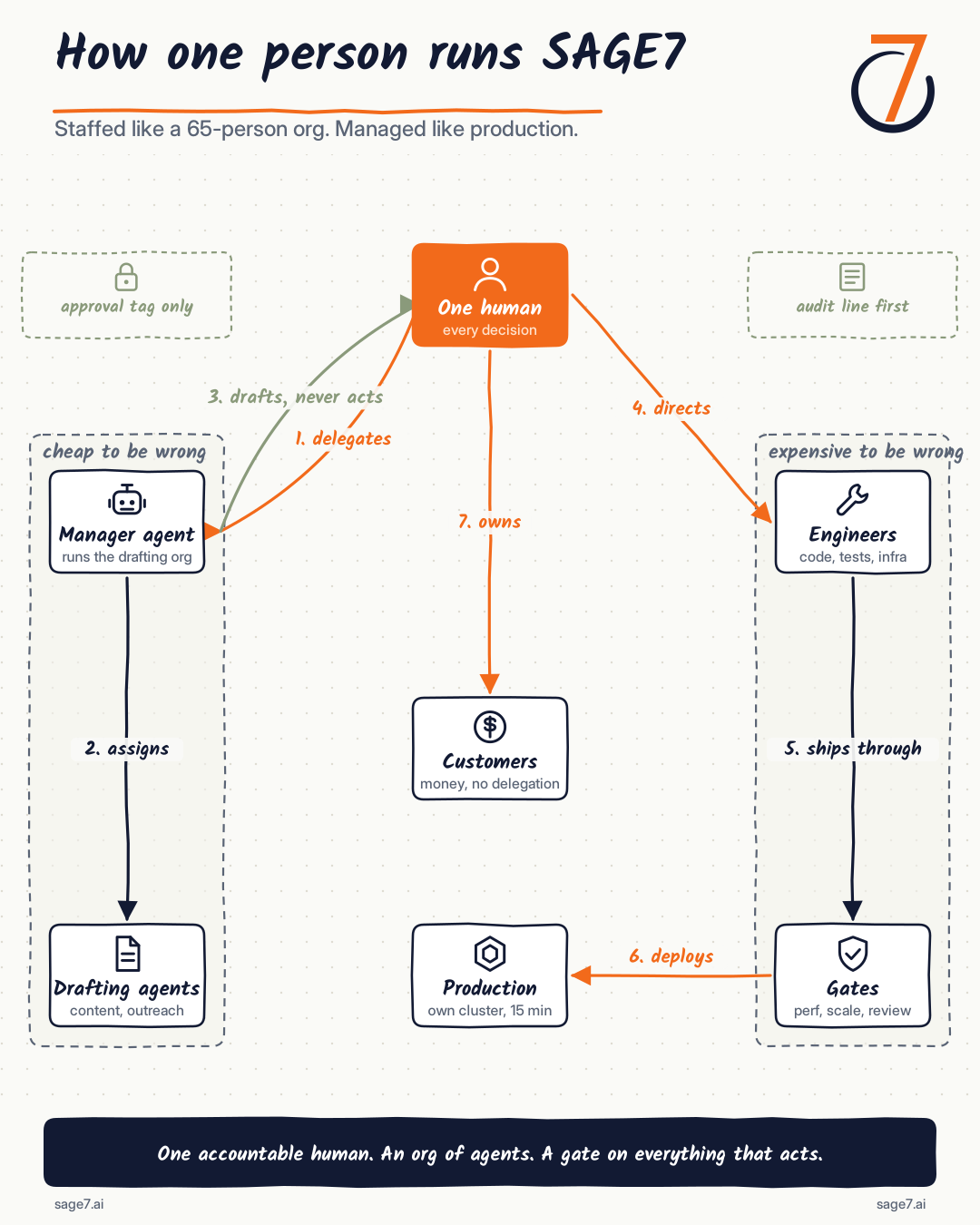
An org chart, not a chatbot
The mistake most solo founders make with AI is to use it as a very fast assistant. You ask, it answers, you paste. The ceiling of that arrangement is your own attention.
I ran SpotHero's data and ML organization from 2 teams to 7, 15 people to 65, across two countries. The thing that made that scale was not any individual's output. It was that every team had a charter, a scope, and a defined set of states it was allowed to move work into — and that I only had to look at the handful of decisions that were expensive to get wrong.
So that is how SAGE7 is staffed. Every agent has a charter (what it is for), a scope (what it may touch), and the statuses it may move work into. A manager agent runs the drafting functions: content, research, outreach, signals. It assigns work, collects drafts, and puts them in front of me. I run the engineering agents directly, because code that reaches production is a different class of risk. And three things are not delegated at all: customers, production, and money.
| Function |
Who runs it |
Gate |
| Content, research, visibility |
Manager agent → drafting agents |
I approve every post; every number traces to a source |
| Outreach and pipeline |
Manager agent → outreach agents |
I approve every send; nothing goes out from a draft |
| Engineering: code, tests, infra |
Agents reporting to me directly |
Performance, scalability and architecture gates before merge |
| Customers, production, money |
Me |
No delegation |
Cheap to be wrong, expensive to be wrong
The org chart only works because of where the line is drawn. The left side of the diagram — the manager and the drafting agents — is allowed to be wrong, because being wrong there costs a redraft. They have no credentials. They cannot post, send, or submit. The only thing a draft can do is wait for one human word.
The right side — engineering agents, gates, production — is expensive to be wrong, so it is gated instead of trusted. An engineering agent can write anything it likes; it can only ship through the same review that applies to me: does it hold up under load, does it scale, does the architecture fit the platform. If it does not pass, it does not merge, however good the prose in the pull request.
Two rules sit across both sides. Nothing acts without an approval tag. And the audit line is written before the action, so a failed action still leaves a record of what was attempted and by whom.
Repo to production in under 15 minutes
The second half of running like a big org is the platform. A 65-person company does not rebuild its infrastructure for every project, and neither does SAGE7.
There is one standing platform: our own Kubernetes cluster, GitOps through ArgoCD, CI that builds and pins images, a namespace and a database per product, observability on all of it. A new product goes from its first commit to a live URL in under 15 minutes, on infrastructure sized for roughly 100k customer interactions a day. The agents ship through that platform and nowhere else, which is what makes the gates enforceable rather than aspirational.
Why this is the product
Everything above is also what SAGE7 sells. Customers — an agentic platform in power generation and storage, finance teams, IT services and talent-management firms — come to us because they want agents that can act on money, data and memory without a human babysitting every step, and without the first mistake ending up in a customer's inbox.
The answer is the same org chart at their scale: a trust boundary that lets one accountable person run a fleet of agents. This page, and the company behind it, are the working prototype.
If you are putting agents near anything that costs money to get wrong, compare notes.