Who signs off on an AI agent's memory: the team that built it?
When a contractor finishes your kitchen, someone else does the inspection. Nobody finds that strange. With agents, the builder usually grades the work. Same team writes the test,…
When a contractor finishes your kitchen, someone else does the inspection. Nobody finds that strange.
With agents, the builder usually grades the work. Same team writes the test, runs it, reports the score.
Memory is where that gets risky. An agent remembers what a customer said last month, then quietly uses it somewhere that customer never agreed to. Nothing crashes. The demo still passes.
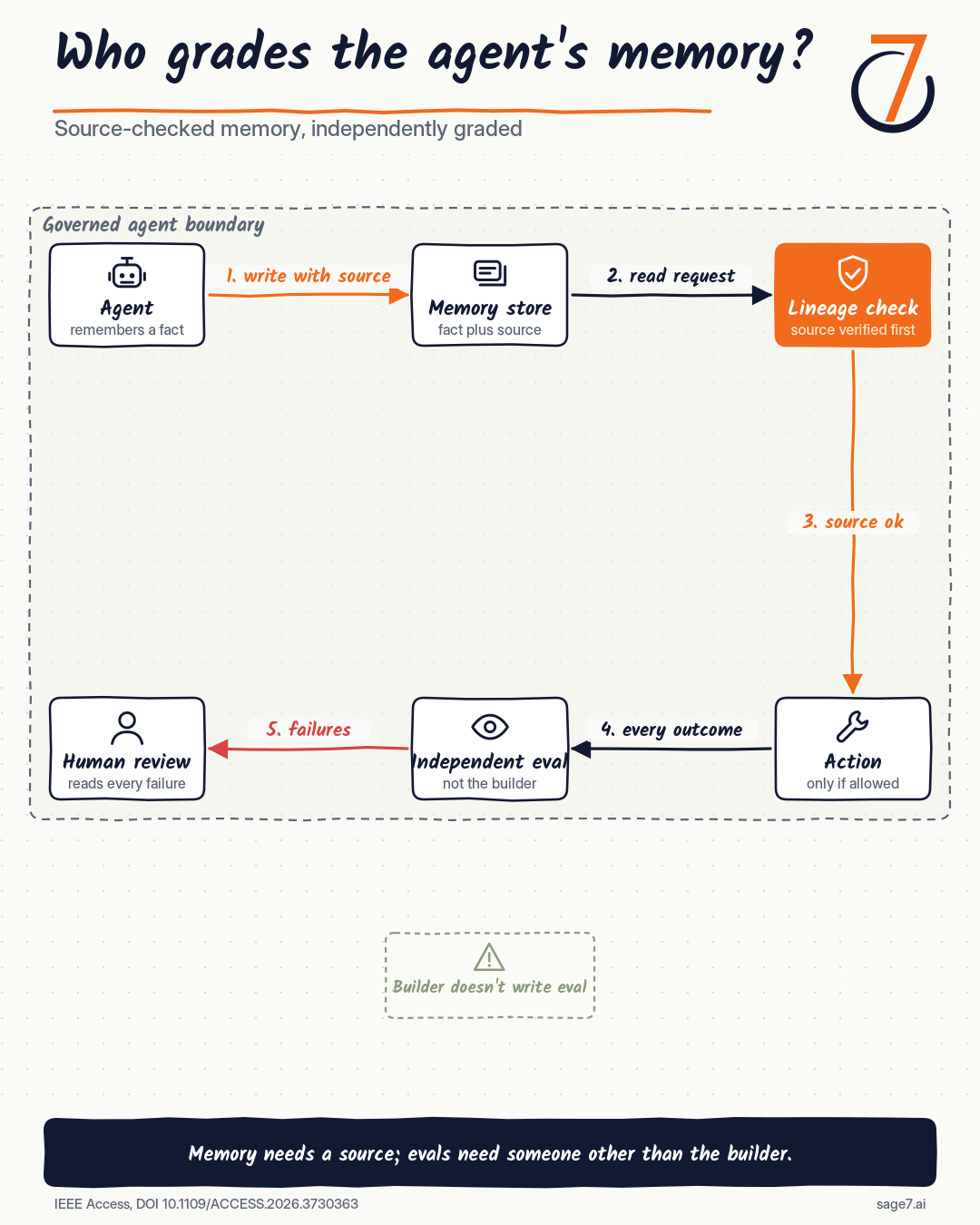
The fix in our IEEE Access paper with Venkata Sangaraju is 𝗹𝗶𝗻𝗲𝗮𝗴𝗲-𝗮𝘄𝗮𝗿𝗲 𝗺𝗲𝗺𝗼𝗿𝘆: every remembered item carries a record of where it came from, and that record is checked before the agent is allowed to act on it.
The org rule that goes with it: 𝘁𝗵𝗲 𝗽𝗲𝗿𝘀𝗼𝗻 𝘄𝗵𝗼 𝗯𝘂𝗶𝗹𝘁 𝗶𝘁 𝗱𝗼𝗲𝘀 𝗻𝗼𝘁 𝘄𝗿𝗶𝘁𝗲 𝘁𝗵𝗲 𝗲𝘃𝗮𝗹.
- A second person writes the cases, including the "this must never appear" ones.
- The pass bar is written down before the run. A 0.5 cutoff is a decision, not a fact.
- Every failure lands in a report a human reads.
None of this needs a heavy framework. Our open-source llm-eval-lite is 𝘀𝗶𝘅 plain checks in stdlib Python: contains, not-contains, valid JSON, and so on.
What does your team test that the builder didn't write?
Paper link in the first comment.
Further reading
Lineage-Aware Memory Governance for Autonomous Agents (IEEE Access, with Venkata Sangaraju): https://doi.org/10.1109/ACCESS.2026.3730363 · llm-eval-lite: github.com/shadowmodder/llm-eval-lite